
Automatic Litter Boxes Are the Future. Litter-Robot Proved It. But Whisker May Be Screwing It Up.
Thirteen years, three Litter-Robots, multiple cats, several repairs, one terrible app, an alarming number of sensors, and a growing suspicion that the Internet should stay the hell out of my litter box.
I hate scooping litter boxes.
I assume nearly everybody does. There are probably people somewhere who claim that lovingly excavating cat shit from a plastic tray every morning brings them closer to their animal. Those people are welcome to their journey.
I wanted out.
About thirteen years ago, not long after Princess Beef joined the household, I started looking at automatic litter boxes. There were rake systems. There was one memorable machine that attempted to wash and liquefy the contents. Every design seemed to come with some substantial compromise.
Then I saw the Litter-Robot 2.
The idea was mechanically obvious and brilliant: put the litter inside a rotating globe. After the cat leaves, rotate the globe, sift the clean litter through a screen, let the clumps fall into a waste drawer, and rotate everything back into position.
No rake dragging through cat waste.
No complicated disposal system.
No plumbing.
Just gravity, rotation and a drawer.
I bought one.
Princess used it almost immediately.
That was the first HOLY SHIT moment.
Quite literally.
The damn thing changed everything
We put the Litter-Robot 2 in our bedroom.
And it didn't smell.
I'm not saying it smelled less. I'm saying you could walk into the bedroom and not know there was a cat toilet sitting there.
This was before I was using modern charcoal-enhanced litter. The LR2 had an enormous piece of charcoal filtering material across the front of the waste drawer, and once the machine cycled, the waste was no longer sitting exposed in a litter pan. It was down inside a mostly enclosed compartment.
At one point I conducted an experiment to see how long one cat could use it before I absolutely had to empty the drawer.
The answer was approximately three weeks.
Do not take that as a maintenance recommendation. It was an experiment, performed once or twice because I wanted to know. Normally I emptied it about once a week.
But three weeks told me something important. This wasn't simply an electric litter scoop. The machine fundamentally changed the amount of my life devoted to cat waste.
More than a decade later, that is still why I think automatic litter boxes are one of the best household technologies ever created for people who live with cats.
The Litter-Robot 2 was primitive and wonderful
The LR2 wasn't perfect.
The opening was relatively small. During emptying, a little door mechanism occasionally didn't catch quite right. Eventually the motor failed.
And that motor failure actually made me like the product more.
The replacement motor cost almost nothing — I remember it being under twenty bucks — and swapping it took me maybe fifteen minutes.
Done. Machine fixed.
That is how expensive appliances should work. If one component wears out, you replace the component. You don't throw a several-hundred-dollar machine into a landfill because a motor failed.
Then we acquired two more cats. That is its own ridiculous story.
For a while everybody fit in the LR2 because the newcomers were kittens. Then Blue grew up.
He became a big, lean male cat — around fourteen pounds at the time — and the LR2 started getting cramped.
So I bought a Litter-Robot 3.
The opening was considerably larger. I was initially a little skeptical of that because I wondered whether it would hurt odor control, but Blue needed the space.
He fit. Problem solved.
Then there were two LR3s
Years later, after another move and the addition of a German Shepherd to the household, Blue became stressed and gained a lot of weight very quickly.
At that point I wanted both litter boxes to accommodate him comfortably.
So I bought another LR3. The old LR2 went into the donation pile, and the two LR3s ended up sitting beside each other.
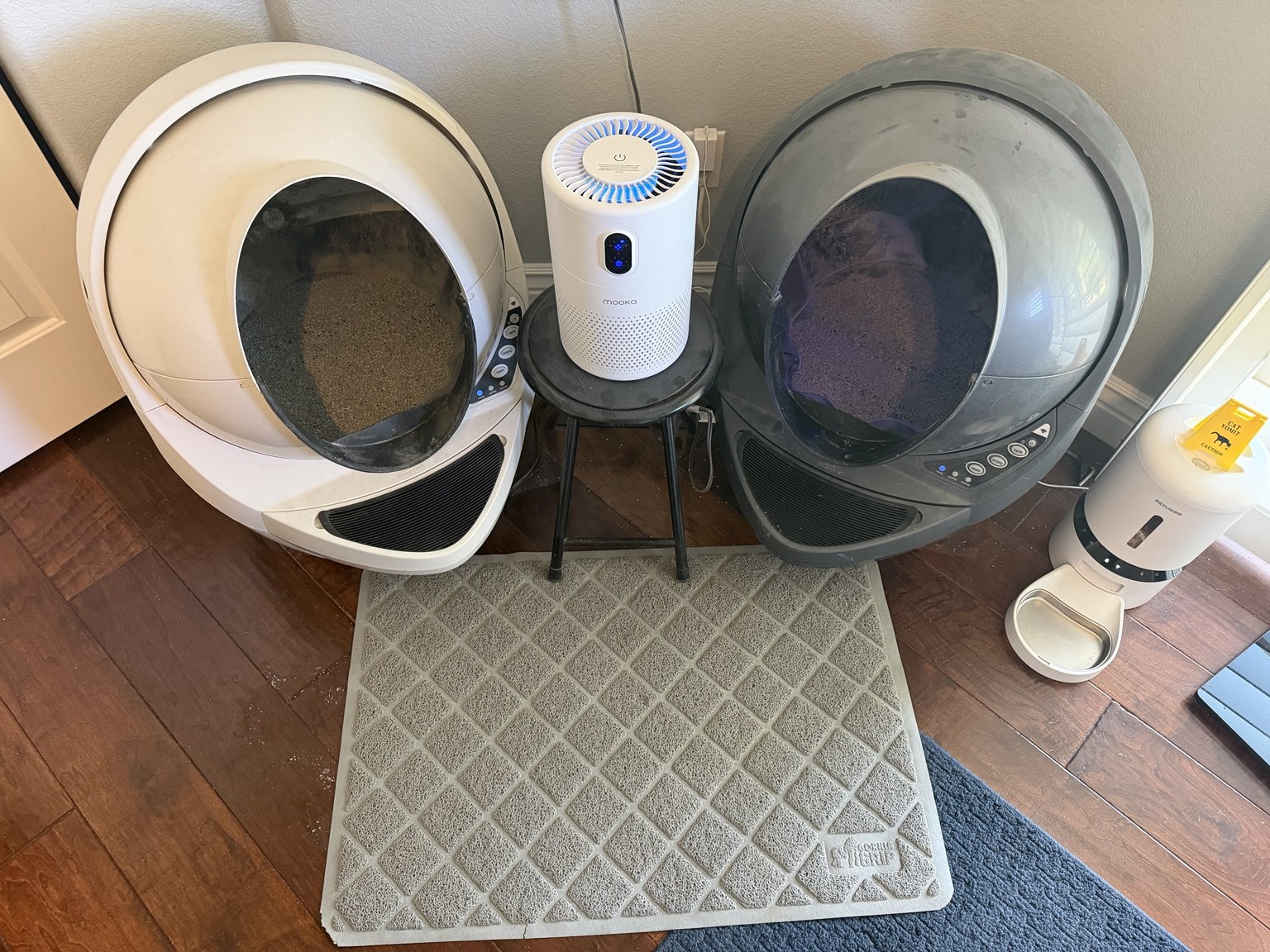
They look almost identical in concept, but my two LR3s are not actually identical machines.
The older one is gray. The later one is beige.
The older LR3 has a noticeable delay after power-up before it begins cycling. I have always suspected that the later unit received a revised controller.
The newer beige LR3 also seems to use different plastic. It feels smoother and is considerably easier to wipe clean.
But the newer machine also has an irritating problem with the rubber liner inside the globe. Either the rubber is stiffer or the weight underneath isn't heavy enough, because the liner does not always sag downward properly when the globe turns upside down.
Which means wet litter sometimes stays stuck to it.
Cat litter plus urine plus time produces a substance with approximately the structural properties of Roman concrete.
We'll come back to that.
Long-term reviews are different from reviews
This is where owning something for years becomes useful. You don't learn this stuff during a thirty-day product review.
The LR3s are mechanically durable. The plastic is absurdly tough. The basic rotating mechanism is simple.
The sensors?
The sensors can go directly to hell.
The pinch sensor
LR3 owners know this one.
The pinch sensor drove me crazy for weeks.
Eventually I took the machine apart, figured out what was causing the fault, and physically forced the contacts to remain connected. That fixed mine.
The bonnet sensor
Then there is the bonnet sensor.
When we lived in humid Marin County, the electrical contacts would oxidize and trigger errors.
I cleaned them. I bent them. I scraped them.
Eventually I discovered that if I unclipped the front of the bonnet and wiggled it around a little, the connectors scraped against each other enough to restore contact.
After moving to the much drier Nevada climate, the problem essentially disappeared.
Apparently some Litter-Robot faults are climate-sensitive.
Wonderful.
The drawer sensor
The drawer-full sensor failed on my newer LR3 while it was still under warranty.
Whisker shipped me the board and wiring harness promptly and at no charge.
The replacement procedure looked fairly intimidating in the instructional videos.
I had it apart, repaired and operating again in under thirty minutes.
Good service. Good repairability.
But again: I'm comfortable taking equipment apart. Somebody who isn't handy could have had a much worse experience.
Actual maintenance: gloves are your friend
Most of the time, these machines require very little attention.
I empty the drawers roughly every five days with multiple cats. I add litter. I occasionally wipe things down. That's about it.
I keep boxes of inexpensive nitrile gloves near the litter machines, and I consider them essential equipment.
One of my male cats sometimes urinates against the inside wall. The resulting clump occasionally adheres to the globe rather than falling away during rotation.
I used to try paper towels. They disintegrated.
I tried cleaning wipes. The smell from some cleaners bothered Echo enough that she didn't want to use the box.
So now I use the highly advanced solution of:
put on glove; remove cat concrete with hand.
It works.
When I'm done, the glove itself goes into the waste drawer. When I service both machines I usually go through maybe three gloves.
That is a very small price to pay for not manually scooping litter boxes every day.
You do not need special Litter-Robot garbage bags
This also deserves to be said.
Ordinary 13-gallon kitchen trash bags work perfectly well.
I've been using standard bags in these things for years.
Whisker itself says its custom liners are not required and that standard 10- to 13-gallon kitchen bags work. On newer machines, white or clear bags are preferable because dark bags can interfere with optical waste-level sensing. Whisker confirms this directly in its FAQ.
You do not need special premium cat-robot garbage receptacles blessed by the manufacturer under a full moon.
It is a bag. Waste goes into it. Then you throw it away.
The Directorate rejects proprietary trash-bag dependency.
Deep cleaning is another matter
Eventually you have to deep-clean the things.
For me that means removing the globe, taking it outside, hosing it down, wiping the base and shaking loose all the accumulated litter.
The base isn't particularly difficult.
The globe is a bitch.
Once old clay litter becomes wet enough, you can work it loose.
The closest physical comparison I can make is:
dried peanut butter mixed with cement.
At that stage it isn't particularly disgusting anymore. It is merely labor.
Afterward I leave the globe outside in the sun for several hours so all the water drains and evaporates.
If the globe could easily open in half, cleaning would be vastly easier.
It cannot.
The cats presumably voted against it.
Litter matters
I've tried a lot of litter in these machines.
Crystal litter. Various clumping litters. Organic stuff.
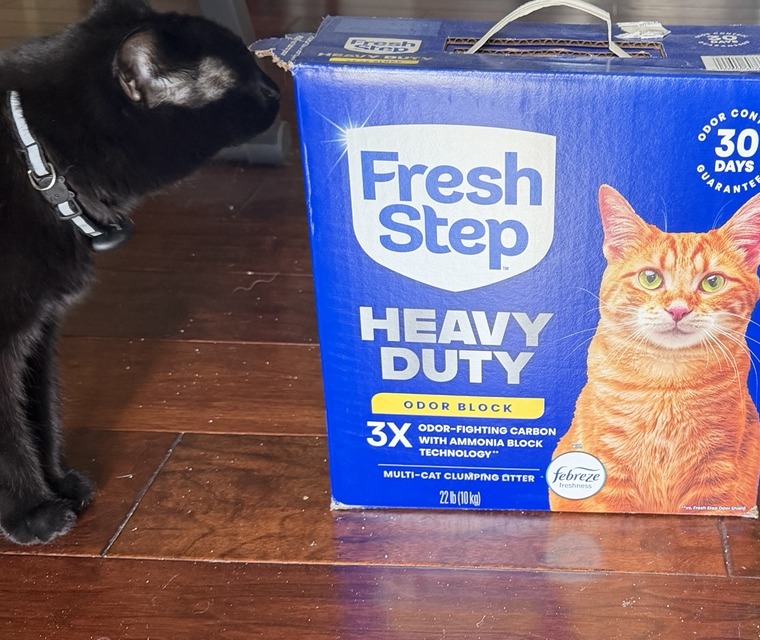
Eventually I landed on Fresh Step Heavy Duty, particularly the charcoal-containing version.
It costs more. It works better.
Good clumping. Very good odor control.
And odor control matters because the fundamental advantage of an automatic litter box is that the waste doesn't remain exposed.
The cat uses the box. The machine waits. The machine cycles. The waste disappears into a drawer.
That alone is a gigantic improvement over a conventional box.
Dust is the part nobody warns you about
There is another side effect of rotating several pounds of clay litter inside a plastic globe:
dust.
A lot of it.
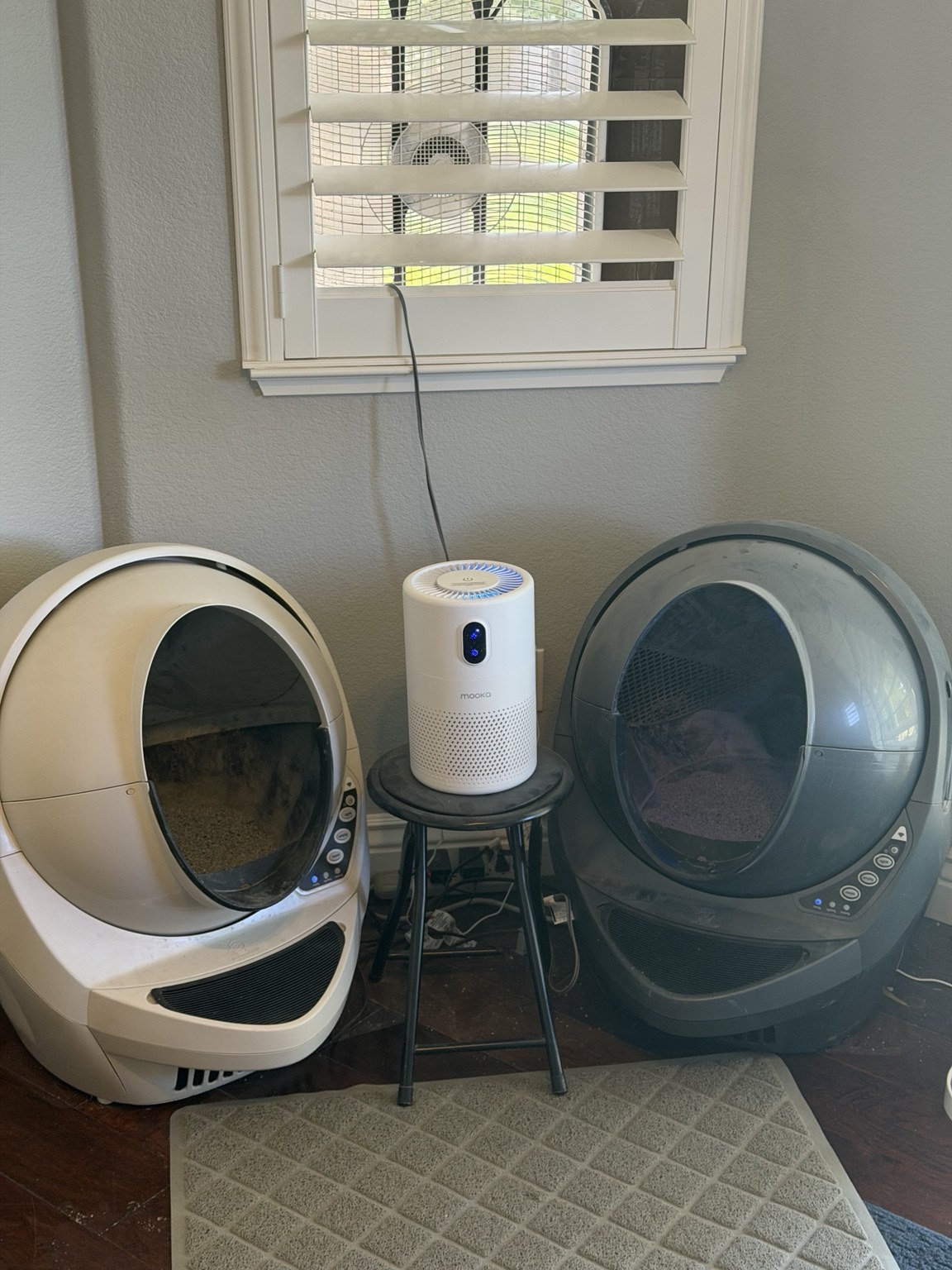
In the photos of my setup, there is a small air purifier sitting between the two LR3s.
That isn't decoration.
It collects an impressive amount of litter dust.
There is also a box fan in the window above the litter boxes. That may be one of the best modifications I've made to the entire setup.
I use a fan speed controller so I can run it below the fan's normal lowest setting. At that speed it becomes very quiet while still maintaining a little negative pressure in the room.
Air comes into the room. Dust and odor go out the window.
Simple. Effective. No account required. No firmware update.
The filter in the small air purifier can also be blown out with compressed air several times before replacement.
Automatic litter boxes are much better if you think of them as part of a litter-management system rather than as an isolated appliance.
The app has always been the weakest link
My LR3 hardware has generally been reliable.
The app has not.
It has always felt buggy.
One of my older LR3s happily connected to an old Orbi network but refuses to cooperate with a newer, entirely normal router.
Eventually I stopped caring.
The machines work without the app.
At night I frequently just turn them off manually so they don't cycle while I'm sleeping, then turn them back on in the morning.
Highly sophisticated automation.
There is even a sleep-mode function, but its rigid scheduling never fit my irregular sleeping habits particularly well.
Button off. Button on. Problem solved.
Here's where my opinion splits in two
At this point, I should make something very clear:
Automatic litter boxes? Fuck yes.
I am completely sold.
I consider conventional litter boxes obsolete technology.
If you can afford a good automatic box, the improvement in cleanliness, smell and daily quality of life is enormous.
Litter-Robot specifically?
That's becoming more complicated.
The machines I own earned an enormous amount of goodwill from me.
They have lasted. I have repaired them. Replacement parts have been available. Customer service treated me well when I needed a warranty component. The basic mechanical design is excellent.
But I increasingly dislike the direction the company is going.
And most of that concern begins with one word.
Subscriptions
Subscriptions for an appliance like this are a hard stop for me.
Period.
Not: “I'd prefer not to subscribe.”
Not: “I hope the subscription is inexpensive.”
No.
Hard stop.
I first became concerned about this direction around 2022, when Jacob Zuppke became CEO. Whisker's own company history confirms that founder Brad Baxter moved into the Chairman and Chief Inventor role in January 2022 and Zuppke became CEO. Whisker documents that transition here.
I remember learning about the recurring-revenue direction around then and thinking:
Oh shit. Don't do this to the litter box.
Whisker now does, in fact, sell Whisker+.
As of this writing it costs $7.99 per month or $79.90 per year and unlocks deeper activity history, bathroom-habit tracking, behavioral “Patterns,” and advanced camera features on compatible devices. Whisker says standard app functionality remains available without the membership. Current Whisker+ features and pricing are listed here.
Good.
I still fundamentally dislike the model.
I'm a tech guy. An old coder. Like decades of experience.
I know what this stuff is doing.
A litter box can record:
- cat enters;
- timestamp;
- cat leaves;
- timestamp;
- weight;
- cycle;
- waste event.
That is data.
Store it.
A phone application can download it.
Then the app can calculate averages. Graph weight. Count visits. Calculate durations. Identify changes. Store history. Export it.
None of that is remotely revolutionary computer science.
You don't need a massive cloud architecture to calculate whether Blue used the litter box eight times this week instead of five.
You need timestamps and arithmetic.
If there is functionality that genuinely requires expensive remote infrastructure, fine.
Long-term remote video storage? Okay.
Heavy server-side AI processing? Fine.
Remote access from anywhere? I understand that.
But basic analysis of data produced by a piece of hardware I already paid for should not require recurring rent.
I bought a scale
I wanted to accurately monitor my cats' weight.
I could wait for increasingly elaborate litter-box cloud analytics.
Instead I bought a Withings scale for about $100.
Now I have an accurate scale.
I own it.
It works.
There is something deeply refreshing about that arrangement.
Money exchanged once. Product acquired. Problem solved.
I would rather buy a dedicated tool than pay a company forever so it can return my own household data to me in prettier charts.
And then Petlibro demonstrated exactly why unnecessary IoT bothers me
Blue depends on an automatic feeder.
Not “we enjoy having it.”
He literally depends on the machine to deliver food on schedule.
In August 2026, Petlibro suffered a widespread service disruption. Petlibro's CEO later acknowledged an August 11 app outage affecting a significant portion of its customer base and said the problem was resolved the next evening. Petlibro's own account is here.
During the outage, users reported feeders missing scheduled meals, remaining offline and behaving unpredictably. Some schedules continued normally; others did not. Those reports matched my own experience: my feeder missed scheduled food.
For a cat.
Whose food depends on the feeder.
This is the perfect example of stupid IoT architecture.
A feeding schedule is tiny.
The machine has a clock.
The machine has memory.
The machine has a motor.
At 6:00:
turn motor.
Why the fuck does a server somewhere need to be involved?
The feeder works again now, thank every available god, but its notifications still arrive at bizarre times.
Something in the system has not been right since that outage.
And I keep coming back to the same question:
Why was this even capable of becoming a problem?
Essential animal infrastructure should fail locally
This is the distinction that matters to me.
If Spotify goes offline, I can't listen to a song.
Fine.
If Netflix goes offline, I can't watch television.
Fine.
If a server goes offline and a machine responsible for feeding an animal stops following its schedule?
That architecture is unacceptable.
And it changes how I evaluate the newer Litter-Robots.
Do I want a litter box that someday refuses to cycle correctly because some cloud authentication service is broken?
Do I want a bathroom appliance dependent on somebody's API?
Do I want to hear:
“Sorry, the cat toilet is experiencing a backend outage”?
Fuck and no.
Core behavior should happen locally. Always.
The internet should be an optional enhancement.
Never a dependency.
Now they put cameras in the litter box
The Litter-Robot 5 Pro contains two AI-powered cameras, supports live streaming and recording, and can visually identify cats. Whisker currently lists it starting at $899. Those specifications are Whisker's, not mine.
I will concede something here.
Visual cat identification is genuinely cool.
If the machine can reliably distinguish Princess from Echo from Blue, then correlate bathroom frequency, weight and behavior with the correct cat, that could potentially identify health changes much earlier.
That is useful.
I'm still not convinced I need it.
Because cameras introduce their own issues.
We've already seen what happens when cameras map houses
In 2022, MIT Technology Review reported that development versions of iRobot Roombas — importantly, not ordinary consumer machines — captured images inside the homes of paid test participants.
Those images were sent through an outside data-labeling pipeline.
Some subsequently appeared in private Facebook, Discord and other groups used by contract workers.
One showed a woman on a toilet.
Another showed a child.
iRobot said the development-unit participants had agreed to video data collection and said sharing the images violated its agreements. It terminated its relationship with the service provider involved. The MIT Technology Review investigation is archived here.
That does not mean normal Roombas were secretly uploading bathroom pictures from random customers.
But it demonstrates something much broader.
Once a camera exists...
once data leaves the device...
once it travels through servers...
once third parties become involved...
you have created a privacy risk that did not previously exist.
So my reaction to two more internet-connected cameras inside my house is not automatically:
Cool! Cameras!
My reaction is:
Why?
I already solved remote monitoring
I point a cheap Wyze camera toward my litter boxes.
When I'm away, I can see whether the globes are upright. I can see error lights. I can see whether the machines are cycling. I can see whether the room has somehow caught fire.
Good enough.
The camera is external to the litter-box system and isn't required for the litter box to function.
That separation matters to me.
Zuppke's vision isn't my vision
Whisker is very explicit about where it wants to go.
The company now describes its strategy as connected products and insights spanning what it calls the “trinity of cat care”: food, water and waste. That language appears on Whisker's own About page.
Zuppke has described the newer Litter-Robot line as one piece of a larger integrated ecosystem using data across waste, food and water products. Again, that's Whisker's description of the strategy.
That is his vision.
I understand it.
I don't particularly want it.
The genius of the original Litter-Robot was that it solved an annoying physical problem with clever mechanical engineering.
It rotated cat shit into a bag.
Beautiful.
Now we're talking about:
AI cameras.
Facial identification.
Behavior analytics.
Cloud services.
Connected ecosystems.
Subscription tiers.
I'm not opposed to technology.
Again:
I'm a tech guy. An old coder. Like decades of experience.
That is precisely why I don't automatically equate more technology with better engineering.
Good engineering is often removing unnecessary components and dependencies.
Why involve the Internet when you don't have to?
I do not want Litter-Box-as-a-Service
I've watched this progression across technology for years.
Step one: buy hardware.
Step two: create account.
Step three: connect hardware to cloud.
Step four: store useful functionality on company servers.
Step five: create premium tier.
Step six: charge customer forever for features the underlying hardware is already capable of supporting.
No.
I bought the thing.
It is in my house.
The cat using it is my cat.
The data is being generated in my house.
If the hardware can collect it and my phone can process it, I should not have to pay recurring tribute to see useful analysis of it.
I am not claiming Whisker currently requires a subscription for basic litter-box operation.
It doesn't.
I am also not claiming Zuppke has announced that all future Litter-Robots will require subscriptions.
He hasn't.
What I'm saying is that I dislike the direction enough that I now consider it when choosing the hardware.
If a future Litter-Robot ever requires a subscription for basic functionality?
I'm gone.
Completely.
I would rather manually scoop a fucking litter box.
That is how hard the line is.
Which brings us to the price
Whisker's current U.S. advertised starting prices are roughly:
| Model | Starting price |
|---|---|
| Litter-Robot EVO | $599 |
| Litter-Robot 4 | $699 |
| Litter-Robot 5 | $799 |
| Litter-Robot 5 Pro | $899 |
Those are base prices, before warranties, hoppers and bundles. Whisker currently lists the 5 Pro LitterHopper bundle above $1,100. Current model pricing is here.
Nine hundred dollars for a litter box is objectively insane.
Which is why competition suddenly matters much more.
If I had to buy another one tomorrow, I'd look at Neakasa first
I've spent hours looking at the current automatic-litter-box market.
The competitor that interests me most right now is Neakasa.
Its M1 family uses an open-top design rather than enclosing the cat deep inside a rotating globe. Current sale pricing is dramatically below Whisker's flagship products, and Neakasa specifically markets the open layout for larger cats. The current M1 lineup is here.
I have not owned one.
That distinction matters.
I cannot tell you whether one will survive thirteen years.
I cannot tell you whether its sensors will eventually make me invent new profanity.
I cannot tell you what the plastic will look like after thousands of cycles.
But after researching the current alternatives, that's probably what I would try next if both LR3s died tomorrow.
And that's a huge change.
For years my answer would have been:
Buy another Litter-Robot.
CatGenie? No.
There is another automatic system I would personally avoid.
CatGenie.
I have never owned one.
A friend did, several years ago.
It was a nightmare.
His machine suffered multiple hardware problems. I remember a failed pump and at least one other component failing. His experience with customer service was bad.
Then there was the underlying design.
CatGenie doesn't simply sift clumps into a drawer. It uses its own washable granules, water, a cleaning solution and a drain connection; the machine liquefies solid waste and sends it through a hose to a toilet or laundry drain. CatGenie's own documentation says ordinary litter cannot be substituted and that the machine requires its specific washable granules. The manufacturer describes the system here.
My friend's discharge line clogged.
More than once.
Eventually, only months after buying the machine, he threw the whole damned thing out.
Maybe the current generation is much better.
I don't know.
But look at the architecture.
You have converted:
cat shit in a box
into:
cat shit, water, pumps, proprietary consumables and a waste hose.
The design violates one of my favorite engineering principles:
do not turn a simple problem into a plumbing problem.
Hard pass.
So after thirteen years, what do I actually recommend?
Automatic litter boxes?
Fuck yes.
Absolutely.
No hesitation.
The technology has changed my life enough that I genuinely consider ordinary litter boxes obsolete for people who can reasonably afford automation.
The cat gets freshly sifted litter after almost every visit.
Waste gets moved out of the open environment.
Odor drops dramatically.
The human stops digging around in cat poop every day.
This is progress.
Litter-Robot?
Still a very good product.
My old machines have earned that statement.
They have been durable. Repairable. Effective. Transformative.
If the automatic-litter-box category disappeared tomorrow and the only automatic machine left on Earth were a current Litter-Robot?
I would buy it.
Would I automatically buy another Litter-Robot today?
No.
And that is new.
The current prices are high.
The competition is real.
The app experience has never impressed me.
The connected-device direction bothers me.
The cameras make me cautious.
And subscriptions are an absolute philosophical deal-breaker if they ever cross the line from optional extras into basic ownership.
Whisker taught me that automatic litter boxes are indispensable.
Whisker no longer has me convinced that the automatic litter box needs to be theirs.
That may be the most interesting conclusion I can give after thirteen years.
AUTOMATED FELINE WASTE PROCESSING: ESSENTIAL TECHNOLOGY.
CONVENTIONAL LITTER BOX: OBSOLETE HUMAN LABOR SYSTEM.
LITTER-ROBOT: PROVEN. DURABLE. EXPENSIVE. INCREASINGLY OVERCONNECTED.
NEAKASA: NEXT PROCUREMENT CANDIDATE.
CATGENIE: PLUMBING INCIDENT UNDER CONTINUING REVIEW.
SUBSCRIPTION-BASED CAT TOILET: DENIED.
Core feline-support systems shall function locally.
Essential behavior shall not depend on remote servers.
Data generated inside the household should remain inside the household whenever practical.
Recurring tribute for basic appliance functionality is prohibited.
Cameras require justification.
“Because we can” is not justification.
LITTER-BOX-AS-A-SERVICE IS NOT AUTHORIZED.